

What a solar battery actually costs in Victoria.
A 10 kWh battery typically lands between $7,000 and $11,000 installed in Victoria after the federal discount of roughly $252 per usable kWh. Smaller and bigger systems scale from there. These are real market ranges for quality gear, checked against published Australian pricing data on 9 September 2026, and your itemised quote prices your actual home.
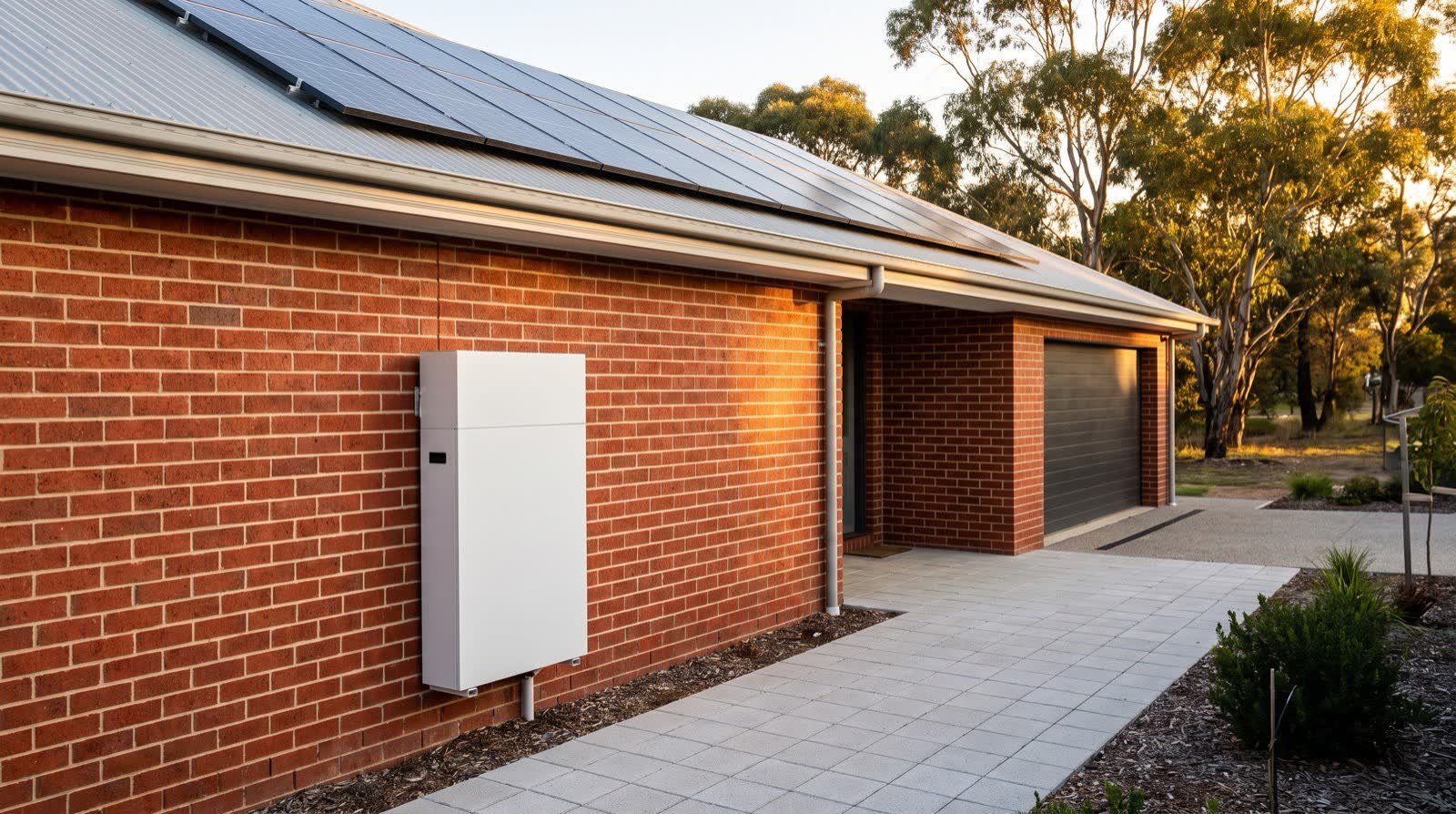
2026 installed price ranges by size.
| Usable size | Typical household | Before discount | Federal discount | Typical installed price |
|---|---|---|---|---|
| 6 kWh | Small home, 1-2 people | $6,500 - $10,000 | ~$1,512 | $5,000 - $8,500 |
| 10 kWh | Family home, 3-4 people | $9,500 - $13,500 | ~$2,520 | $7,000 - $11,000 |
| 13.5 kWh | Family + EV or heavy evening use | $11,000 - $16,000 | ~$3,400 | $7,500 - $12,500 |
Market ranges for quality systems, compiled from published Australian installer and comparison-site pricing and checked 9 September 2026. The discount is approximately $252 per usable kWh on the first 14 kWh and tapers above that. Individual quotes can land outside these bands for premium brands, complex installs or aggressive promotions.
Why one 10 kWh quote is $7,000 and another is $11,000.
- Brand tier. Premium names carry a premium. Quality mid-tier units perform for thousands less.
- Inverter situation. A hybrid-ready inverter keeps costs down; needing a new one adds to the bill.
- Backup circuits. Whole-home blackout protection costs more than essential-circuits backup.
- Switchboard and siting. Older boards and tricky mounting locations add labour, and Australian standards dictate where a battery can legally go.
Our quotes itemise every one of these, so you can see exactly why your number is your number.
How long a battery takes to pay back in Victoria.
The price is only half the question. The table uses a 10 kWh battery at a net cost of about $9,000, the middle of the range above, cycled once a day. Each kWh you store and use instead of buying back is worth the gap between your usage rate and your feed-in tariff: about 25c on a single-rate plan and about 35c if you would otherwise be buying at the 4pm to 9pm time-of-use peak. Simple payback ignores degradation and finance costs, so read it as a best case.
| Victorian household | Solar stored and used per day | Approx. annual saving | Simple payback on ~$9,000 |
|---|---|---|---|
| Quiet evenings, single-rate plan | about 5 kWh | around $450 | around 20 years |
| Typical family, single-rate plan | about 8 kWh | around $730 | around 12 years |
| Typical family plus a VPP credit | about 8 kWh, plus $100 to $250 a year | around $850 to $1,000 | around 9 to 11 years |
| Heavy evening use on a time-of-use peak (EV, electric heating) | about 9 kWh | around $1,150 | around 8 years |
Why the gap matters so much in Victoria: the state scrapped its minimum feed-in tariff on 1 July 2025, so exported solar now earns whatever your retailer chooses to pay. The peak rates below are the 2026-27 Victorian Default Offer figures published by the Essential Services Commission, which also confirms there is no longer a minimum feed-in tariff.
| What happens to 1 kWh of your solar | What it is worth to you (VIC, 2026) |
|---|---|
| Exported to the grid at a retailer feed-in tariff | about 4 to 8c, and some retailers now pay less, even 0c |
| Stored and used instead of buying on a single-rate plan | about 25 to 35c |
| Stored and used instead of buying at the 4pm to 9pm time-of-use peak | about 38 to 48c depending on your distribution zone |
Battery cost FAQ.
How much does a solar battery cost in Victoria in 2026?
Typical installed prices after the federal Cheaper Home Batteries discount: around $5,000 to $8,500 for a 6 kWh battery, $7,000 to $11,000 for a 10 kWh battery, and $7,500 to $12,500 for a 13.5 kWh battery. These are market ranges for quality systems; your written quote prices your exact home. Figures checked against published Australian market data on 26 August 2026.
How much does the federal battery discount take off?
Approximately $252 per usable kWh on the first 14 kWh of capacity, typically applied as an upfront discount on your quote. That's roughly $1,512 off a 6 kWh battery, $2,520 off a 10 kWh, and about $3,350 off a 13.5 kWh. Above 14 kWh the per-kWh support tapers, so a bigger battery doesn't keep earning the full rate.
What affects where a quote lands inside these ranges?
Brand tier is the biggest factor: premium units cost several thousand more than quality mid-tier ones. After that: whether your existing inverter is hybrid-ready or a new one is needed, switchboard condition, backup circuits for blackout protection, and installation complexity. An itemised quote shows each of these as its own line.
Are there rules about where a battery can be installed in Victoria?
Yes. Australian standards restrict where batteries can be mounted: not in habitable rooms, clearances from windows and doors, and fire-rated backing on some wall types. A compliant installer handles all of it, and it's one reason quotes vary between homes. If someone quotes without asking where the battery will go, be suspicious.
Is a battery worth it in Victoria without solar?
Usually the maths works best with solar feeding it. A battery charged only from the grid saves the gap between off-peak and peak rates, which is thinner value than storing your own solar. Most Victorian installs pair the two, and the federal discount can apply to eligible batteries whether you add to existing panels or install both together.
When does the battery discount end?
The Cheaper Home Batteries Program is legislated through to 2030, but the STC factor behind the discount steps down on a fixed schedule: 6.8 per usable kWh for installs to 31 December 2026, then 5.7 from 1 January 2027, 5.2 from 1 July 2027 and 4.6 from 1 January 2028. A 10 kWh battery goes from roughly $2,520 off now to about $2,110 off in January, which is the honest argument for sooner rather than later.
How long does a solar battery take to pay back in Victoria?
For a 10 kWh battery at around $9,000 after the federal discount, roughly 12 years for a typical family on a single-rate plan, about 20 years if your evenings are quiet, and around 8 years if you shift heavy evening load (an EV, electric heating) off a time-of-use peak rate. A VPP credit of $100 to $250 a year trims another year or two. Victoria pays back slower than sunnier states because feed-in tariffs are low and the state has no battery top-up, so the case rests on evening usage and backup value, not the headline rebate.
Go deeper.
- Cheaper Home Batteries Program: how the federal discount works
- Solar and battery packages: panels plus storage priced together
- Tidy Battery: the install side, done properly
- Rebate calculator: estimate your stack for your postcode
60 seconds to your battery number.
Your postcode and a couple of quick questions. We'll ring to lock in a time and that's it.
Get my tidy quote